CHAPTER FOUR
LATER PRESCHOOL YEARS
When I was still too young to go to school we moved from grandfather Park's farm into the corner house in Fair Ground, where my grandfather Cutler had been living. By this time grandfather Cutler had built a concrete block house for himself a few hundred feet to the west, next to the Methodist Church, where he and grand mother Cutler now lived. Grandmother Cutler was suffering from heart trouble and was no longer able to take care of the corner house, which served as a stopping place for the few travelers who came through Fair Ground.
After we moved in, I remember visiting grandma and grandpa Cutler in their new home. It was very comfortable and pleasant. Grandma Cutler was a stoutish woman and not very tall. At that time her own mother, my great grandmother Edmonds was with her. She too was built like her daughter, my grandmother Cutler. There was a piano at one end of the room, and over the piano was a huge picture of grandfather and grandmother Cutler. I don't remember much about my grandmother Cutler. I suppose because she was not well I didn't see much of her. She died of heart trouble at 56 years of age.
My grandmother Cutler had a sister Mary who was married to Ben Purdy. They lived about two miles west of Fair Ground. She was my mother's Aunt Mary and we also called her Aunt Mary. She was not well either, but she was a fine Christian woman and a member of the Free Methodist Church, which was near to her house. Her husband Ben, however, was somewhat shady in his dealings, although he too was a Free Methodist.
Grandmother Cutler's brother George Edmonds was the youngest of her family. He lived on the Edmonds homestead a few miles away, north of Kinglake. His home was in a pine forest. He was my mother's Uncle George and we also called him Uncle George. He had a small mill where he made pumps, using the pine trees of his forest. These of course were wooden pumps but they functioned very well, and he had a good business selling and installing them around the country. When he passed through Fair Ground he always stopped and stayed overnight at our place. He was a pleasant bald-headed man. He was nice to us children, and we were always much amused at the way he would wiggle his ears for us. George Edmonds had three children, Cora, Orlaf and Allie. Orlaf was quite deaf. We used to see these cousins of mother's occasionally.
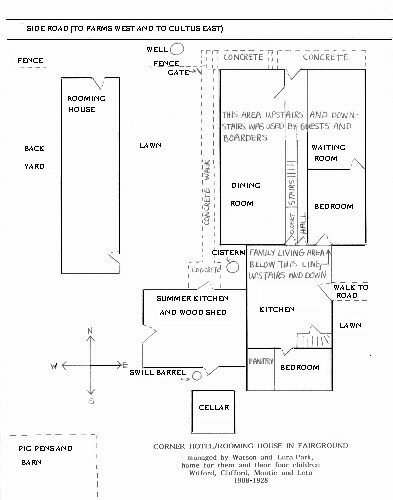
Our home on the corner was quite a sizable structure. It had a concrete area about eight feet wide which went across the whole north side of the house. ft was up about two feet off the ground, to accommodate the traveling clientele with horse- drawn buggies and democrats. There was a central doorway opening into a hall, and stairwell leading to the upstairs. At the eastern side of the hall entrance was a small room where travelers could sit together and talk and smoke. Behind this was my father's and mother's bedroom. On the opposite side of the hallway entrance was a large dining room where the guests and boarders were fed. Upstairs there were four bedrooms and a comfortable sitting room, chiefly for the female guests. At the head of the stairs, on the second floor, was a considerable space which my
20
father used for his barbershop. From this area a door opened onto an upstairs porch which was about eight by ten feet in size with a railing around it. It was supported on the roadside by two sturdy posts, which went down to the concrete platform below. All of the above mentioned area was for the use of paying guests.
The rest of the house extending backwards toward the south was our family living quarters. The first was a large room, in which there was a large wood-burning cookstove. This room also served as a dining room for the family. Behind this large room was another bedroom and a pantry. Upstairs in this part, with its own stairway, were three bedrooms with a hallway large enough for a fourth bed. Up here is where we four children slept and also the hired girl whom my mother used.
One intriguing place for us children was a large clothes closet under the front stairway. It was dark and narrow and opened only into our living quarters. From our kitchen-living room, another building was attached to the house, on the west side. This was a large poorly-constructed building, which was more of a woodshed than living quarters. However, it was used in the summer time for cooking and our eating of meals.
Just to the west of the above building-complex was another separate large two-story building, which was used as rented quarters for families or boarders. During the days when the sawmill was operating full blast, all of these accommodations were occupied, mostly by people working at the mill. Most of them were served in the large dining room where two long tables went the full length of the room. You can visualize how busy my mother was cooking for all of these people.
There was no inside plumbing but there were two outside toilet buildings on the property. There was a good well just outside of the fence, actually on the road, with its trough for watering horses. There was also a large cistern close to the main house, where water was collected off the roofs of the large buildings. Mother had a big sink where she could wash vegetables and dishes with the water running through a large drainage system into the sandy soil.
The large rooms had their own wood stoves. The upstairs rooms were mostly unheated but did get some heat from the rooms below through doorways or openings in the floor through the ceiling of rooms below. In our early days there, the only source of light, at night, were kerosene lamps.
There was no electricity and no refrigeration. Mother did, however, have a cold box which was kept cold by huge chunks of ice which my father brought in regularly from his winter hoard of ice blocks, buried in sawdust in his ice house.
Potatoes and some other vegetables were kept in an underground root-cellar. There were large bins of them in this huge dark place, entered by stairs leading down into it through a heavy insulated door. This whole grotto was covered over by a large mound of earth about 50 feet to the south of other buildings. This home, on the corner, was where I lived from four or five years of age until I started to university at age 20.
When we first moved into this property, my grandfather Cutler still maintained, on the back of the lot, about six or eight beehives. We of course were wisely kept away from the bees. But we liked to look at them, as they went on their busy lives
21
of going and coming in huge numbers, as they gathered honey. We watched too when they swarmed. At this time they hung in a huge clump, usually. on a low branch of a nearby tree. The clump of bees clinging to each other was about five inches across at the branch level, and hung down in a cluster of bees about six or seven inches deep. To keep them from getting away, grandpa Cutler dressed himself in thick clothing, with a straw hat on his head. Over his hat and his face down around his shoulders, he had on a large piece of fine net, which the bees could not get through. Over his hands he had heavy gloves, with ties around his wrists so the bees could not get inside his clothing. Dressed like this, he calmly and slowly approached the clump of bees, carrying a new empty hive, open at the top, and carefully shook the bees down into it. When all of the bees were in it, he put on the cover and placed it with the other hives. So long as the queen bee was with them the bees stayed together. When the queen bee found herself in a new spacious hive, she promptly set up housekeeping, and the other bees started to gather more honey.
In the process of gathering the honey from the hives, grandfather dressed as above and forced smoke from a gadget into the hive, and when the bees were stupefied by it he took out the full honey sections and supplied the bees with new foundations, on which they could build more honeycombs.
To the west of the houses on the corner already mentioned and east of grand father Cutler's new house farther to the west was a large barn. The ground floor of this barn opened directly onto the road, because it served as a livery stable. There were several stalls for the horses of traveler-guests and shelter for their vehicles. Above, and attached on the south side of it, were mows for hay and straw. There was also a granary on the ground floor which contained oats for the horses. Farther back on the ground-floor level was space for farm cows and pigs and a larger granary. There was also a fenced-in space for the cattle and pigs which allowed them to be outside.
Between our houses and the barn was a row of black currant bushes and a red cherry tree. The soil was sandy and weeds were plentiful, among them catnip, horehound, burdock and hemp. My father allowed his fattening pigs to have the run of this area. I remember, on one hot summer day, one of these fat pigs was not as lively as the others, so it was easy for me to climb onto its back. For a little while I rode around thus, with the pig puffing from the heat. After I tired of it, the pig lay down in the sand next to the house. The next morning that pig was found there dead.
When the cherries were red in the cherry tree, one day Clifford and I were up in the tree stuffing ourselves. While there, I discovered it was no trouble to swallow the cherry pit. From that day on I had no trouble swallowing pills.
During those boyhood days we needed some simple toys to amuse us, so my father made us some tops. They were fashioned out of empty spools, which were plentiful in those days and had deeper flanges than in modern days. From one empty spool he made two tops by cutting it in two and fitting short pieces of wood into the holes, and shaping the inside end of the sticks and spools to a point. We spent long hours spinning them. He also made us fine spinning wheels, by threading strong cord through two of the holes in large coat buttons. We learned to wind these up in the center of the double cords and made them spin so fast that they would wind themselves up for a reverse spin when we pulled the ends apart and relaxed and pulled them alternately.
22
Every once in a while a peddler would come along with his heavy suitcase packed with things to sell. We were always on hand to look at his fascinating wares. They included such things as thread, needles, pins, combs, buttons, eye glasses, all kinds of trinkets and cheap jewelry, etc.
Another kind of peddler, whom Mother was always glad to see, was the fishman. He came from Pt. Burwell, with a flat wagon pulled by one horse. The wagon was covered by a wet tarpaulin and water was dripping through the floor boards. Under the tarpaulin were chunks of ice and among them a large assortment of fresh-water fish, of all sizes, from Lake Erie. We had never seen such large fish before. Mother always bought some, often pieces of the large fish.
When the sawmill was operating there were always a lot of men-boarders standing around, and sitting on the concrete in front of our house after the evening meal was over. They frequently wanted some amusement, so when one of my playmates, Billy Sutherland, was there, they egged us on into a fight. Billy was a little bigger than I, and was in favor of it, because he knew he would always win. I didn't want to fight, but I could hardly get out of it when he attacked me. So many times I took a beating, but was never seriously hurt. Even so perhaps it helped to toughen me.
Another form of sport which we boys enjoyed was playing with a hoop. We found either wooden hoops or iron ones, which had fallen off discarded barrels. These we rolled along at top speed, keeping up with them and propelling them farther along with a short stick.
Another place where we were allowed to play was behind the Gates General Store where there was always a collection of empty packing boxes. We pushed these around and crawled into them and fashioned pretend houses, etc.
Another favorite play area was in the lumber yard on Frank Williams' farm, across from the mill. This was a fine place for hide-and-seek because there were many piles of lumber in many directions, so that we could not see far anywhere. Furthermore, because the lumber was of different lengths, there were many crevices at one end of each pile, where we could crawl into and hide.
The saw mill itself had interesting features, among them the puffing of the steam engine, and the movement of the logs into the huge spinning saw with a board falling off each time when the saw reached the end of the log. Another interesting process was the cutting of the barrel staves from the long blocks of wood which had been softened by soaking in hot water. The huge knife came down and cut them off, one at a time, like slicing through cheese.
Another process, which we liked to watch, was the making of barrels in the mill cooper-shop. The barrel staves and heads were held in place mechanically, while the men applied the hoops and tacked them into place.
Jack Robbins and his family lived near the cooper shop. They had a small barn, where they kept a goat. The goat had horns but was mild-mannered and cooperative, so the Robbins' children had a harness made and had the goat trained to pull them around on a wagon. We children joined in the fun and followed the goat around too. Sometimes they even came as far as our corner with the goat.
23
It was in Fair Ground that I saw my first automobile. It was one of those open ones with a straight up-and-down windshield with much brass all over it. Brass was on the sides of the windshield, on the front of the engine hood, on the elegant head lights and on the lamps at the side of the seat. The seat was open, with no side doors and no top over it. This novelty was an attraction to everybody, but it didn't move fast. It had bare white tires and wooden spoked wheels. The horn was a brass gadget which was sounded by squeezing a large rubber bulb.
A lot of the mill workers and the boarders were quite heavy drinkers of liquor, which they got somewhere, but certainly not at our house. Sometimes some of them even came to dinner too drunk to behave themselves. On one occasion some of them got in an argument and started a fight right in the dining room. The result was upset tables with the floor covered with food and broken dishes. The dinner was broken up and nobody had a chance to finish the meal. We children were home, and heard it going on, but were not allowed to look in, until all of the boarders had gone out. Then we saw the mess which my mother and father were left to clean up. I don't know whether or not the men got together a purse to pay for the damage, but I suppose they did.
One of the regular roomers, who lived in one of the rooms upstairs in our main building, was a nice Dutchman by the name of Krause. He had to fight the drinking urge all of the time. Usually he held out for a month or more at a stretch, but when he started to drink he couldn't stop. In these bouts, he stayed in his room and kept drinking as long as he had any liquor, and would eat nothing. At these times, the only way my mother and father could help him was, if possible, to keep him from getting more liquor. At one of these times, a long-legged young man by the name of Long was determined to get more whiskey to Krause. My mother had the doors locked so he couldn't get in. But after banging around at all doors and mother refusing to let him in, he thought he might put one over on her by climbing one of the posts supporting the veranda, and get to Krause through the upstairs door from the veranda. The door was actually unlocked at that time, but through the window, we saw him climbing up there. So mother sent Clifford and me upstairs to lock that door. We ran upstairs and turned the key in the lock before he reached it. So Mr. Long was foiled in all his attempts and eventually went away.
One of the last things I remember of my preschool days was being awakened at night, and standing at our upstairs bedroom window, watching the fire as the sawmill burned down. The loss of the sawmill brought an end to father and mother's boom days. All of the roomers and boarders left and Fair Ground reverted to the small quiet hamlet it always was. The residents of our large rooming house all moved away, and the main building again was supported only by traveling people going through.
24